Sunday, 29 April 2012

Video Intro for Upcoming MOOC and IU Press on the Event

With 2,800 people already signed up for the Blackboard MOOC (Massive Open Online Course) that starts this Wednesday at 4 pm EST, I was asked to do a video intro (see below). It is a little over 12 minutes long. It was the longest of the 5 or 6 takes we made last week Thursday afternoon. I try to explain the upcoming events in the MOOC. We will meet every Wednesday in May at the same time.
Video Intro to Blackboard/CourseSites MOOC. Dr. Curt Bonk: Instructional Ideas and Technology Tools for Online Success, 12:25, April 27, 2012.

I had a ton of support from people in the Instructional Consulting (IC) office within the School of Education at IU. Thanks Peter. Thanks Karen. Thank Eulho. Thanks Miguel. Thanks everyone.

The registration for the MOOC will remain open during the course.

As I said, IU has been highly supportive. Last week, there is a university press release (IU School of Education professor Bonk to deliver free online course on online teaching) as well as an article in the student newspaper (the Indiana Daily Student or IDS; i.e.,
"IU Professor to offer online teaching course"). And my instructional systems technology (IST) department had a short online news story as well (i.e., Open Web Course Launching in May, April 26, 2012).

This is the largest class I have ever done. There might be more people enrolled in this one class than all my combined classes during my 23 years of teaching in higher education since my doctorate. It will be a fun experiment. My blog post from April 19th has most of the relevant information in it.

I look forward to meeting some of you in a couple of days. And, of course, I definitely cannot wait to see a few old friends and former students around the planet. The focus of this MOOC will be pedagogy or instructional strategies for teaching online, though it will also include much information on emerging learning technologies. Time for bed.

Sunday, 22 April 2012

Here's My Spin on "Chronicle Spring"

Chronicle Spring: Anyone out there flipping through the online or "wired" version of the Chronicle of Higher Education lately? It is filled with advice columns each week (and sometimes daily). The weekly paper version is too. Articles can be found on completing dissertations, writing and modifying resumes, applying for jobs, job interviewing techniques, midcareer mentoring, when and how to give notice that one is leaving for another place, departing or retiring from academic life, and so on. There is so much advice out there, my head is spinning.

The past 6 or 7 weeks have given us all ample stuff to read about life as an academic in between grading papers, serving on committees, and conducting research. Given that we had "Arab Spring" last year (see this interactive timeline of Arab spring from the Guardian), I think we should name the spring of 2012, "Chronicle Spring." There sure is a plethora of career advice and mentoring articles coming from the online Chronicle of Higher Education the past month or two to support that notion. Listed below are a few such articles; most of these are from the past couple of weeks, but all are less than two months old.

Ten Sample "Chronicle Spring" Articles:
1. My Terrible, Horrible, No Good, Very Bad Dissertation, April 8, 2012, Rachel Herrmann, The Chronicle of Higher Education.

(Note: The essence of the above article--get done! Few people write dissertations that change the world. As I said, get done! I tell my students the same thing. Sure, 1 or 2 doc students in 10 (at most...more like 1 in 20 or 1 in 100) will come up with a fantastic new model, theory, instrument, research method, etc. But the vast majority will not. Most of them, however, will provide useful insights into some topic area and nudge their chosen field ahead a bit, but their work will not be of the earth-shattering variety that is reported in Time, Nature, or Washington Post.)

2. Midcareer Mentoring, Part 1, March 19, 2012, Female Science Professor, The Chronicle of Higher Education.

3. Midcareer Mentoring, Part 2, April 16, 2012, Female Science Professor, The Chronicle of Higher Education.

(Note: During the past week or two, I have shared the above two articles on "midcareer mentoring" with many friends and colleagues who recently obtained tenure and many of them quickly returned notes of thanks. Apparently, this article about strikes a chord with people as they think about whether it is time to leave their current institution or organization or perhaps to stay and perhaps retool with a sabbatical.)

4. Why I Tossed Your Résumé, April 17, 2012, Brent Miller, The Chronicle of Higher Education.

(Note: This article has some quick comments on why your resume may be tossed from the pile of applications into the nearest bin as well as an insight or two or how to get one's resume/CV noticed and perhaps get the job. It is personally funny and touching in parts since I have experienced many of the things mentioned when on search committees in the past.)

5. Graduate Schools Need to Improve Career Counseling, Report Says, April 19, 2012, By Stacey Patton, The Chronicle of Higher Education.

(Note: According to this article, "the number of jobs requiring a master's degree will increase by 22 percent over the next eight years, and the number of jobs requiring a doctorate or professional degree will increase by 20 percent." However, there is limited career counseling for graduate students about their respective job options. This lack of help on career pathways and options could be a reason that these advice and mentoring articles in the Chronicle of Higher Education are so popular today.)

6. The End of the Affair (about the pain of turning down a job offer), April 18, 2012, George David Clark, The Chronicle of Higher Education.

(Note: This is a short article that has also struck a chord with friends of mine who had difficulty accepting one offer over another.)

7. You Will Not Reject Me. I Will Reject Me, April 17, 2012, Allison M. Vaillancourt, The Chronicle of Highe Education.

(Note: The essence of this one is that many brilliant people lack the personal confidence to apply for jobs for which they are interested and are highly qualified. Very sad I think. As such, it is an important article to quickly skim through and reflect upon. Is that you?)

8. A Few Thoughts on a Graceful Exit, April 20, 2012, Gene C. Fant Jr., The Chronicle of Higher Education.

(Note: Clearly, you should be fair to those around you when you have a job offer that you are likely taking or indeed have taken. If you have hired the movers and scheduled a pick-up time for your furniture and put your house on the market, you better tell someone you are leaving and need to be replaced on the fall or spring teaching schedule.)

9. Work-Life Balance Is Out of Reach for Many Male and Female Scientists, March 8, 2012, By Audrey Williams June, The Chronicle of Higher Education.

(Note: this article uses a recent survey data report to foster a discussion of better ways to foster a work-life balance; especially in STEM fields. According to this survey of over 4,200 scientists and researchers around the planet, 48 percent of women were not pleased with the way work and personal life mesh, whereas that drops to 39 percent for men. Both figures are way too high.)

10. In the midst of all of these advice articles, of course, there are discussions about salaries. And there are charts and tables to lend support to such discussions. For instance:

Professors Seek to Reframe Salary Debate, April 8, 2012, by Audrey Williams June, The Chronicle of Higher Education. Along with that article is an interactive Table of salaries and detailed data on the different colleges profiled.

(Note: Definitely worth playing with the interactive data chart. It is eye opening to see where my university ranks when compared to other places around the USA.)

Ten Causes of Chronicle Spring:
Had enough of all these articles? Me too. I have enjoyed each one but my brain is going a tad mushy with all the advice, recommendations, and data points. I think there are many reasons for the increase in all the advice and guidance columns and increasing need for career mentoring. Here are ten such reasons (as you can see, I do like the number 10).

1. Spring, Spring, Spring: It is springtime and people are getting interviews for new positions and pondering whether to leave their current institution or organization or not. In addition, spring is a time for renewal and reflection. Summer is around the corner, and if you do not teach at that time, it can be a time for much writing productivity and advancement of one's research. These advisory types of articles can help one plan for summer.

2. Jobs, Jobs, Jobs: The job market is clearly picking up. Seems nearly all my current and former students on the job market are getting interviews and some of them have multiple job offers. That was not the case a year or two ago. Part of the reason is retirements. Of course, all is not rosy for those getting positions today since, at many institutions, the faculty replacement policy is 1 person being hired for every 2 or 3 retirements. As such, mentoring and advice is needed on whether to take such a position.

In my current discipline, instructional and educational technology, things are really heating up. The Chronicle of Higher Education, in fact, has been documenting some of the current explosion in venture capital for learning technology companies (see list of start-ups at the bottom of this article on Piazza; there are others as well; 3 Start-Up Announcements From the Education Innovation Summit and Online-Education Start-Up Teams With Top-Ranked Universities to Offer Free Courses). As you pan through such articles, it is clear that there are many job opportunities out there for those who want to work outside of academia.

In addition, nearly all college and university campuses and government agencies now need instructional design and distance or e-learning learning support for their online and blended courses. Those seeking a job in instructional technology, educational technology, or e-learning on a college campus or in a government, corporate, or military setting (or even in a school district), might see the jobs portal from my department (Instructional Systems Technology (IST)) at Indiana University or my personal portal of over 30 job Website portals. And there's always the jobs database from the Chronicle of Higher Education to peruse through.

3. Mistakes, Mistakes, Mistakes: Because we are coming out of a recession, no one wants to make a mistake and pick the wrong place to move to or make a bad decision of any kind. At the same time, most people do not want to wait too long to make a move. It is a nerve-wracking situation for many. They need advice and mentoring.

4. Information, Information, Information: So many articles to read and learn from in order to stay abreast of what is happening today. So much to consider in terms of one's career. How can anyone keep track of it all? I know lately I have seen a surge of people seeking advice about their careers, whether they be graduate students, assistant professors, or associate professors. Some want advice on writing their resumes or CVs. Others want to know about interview questions that they might be asked (see my blog post on that). And others want to know whether they should focus their careers in a couple specific areas; and if so, how. That is just a small sample of the questions I am getting the past few weeks.

5. Flow, Flow, Flow: Some people are seeking happiness and flow. They want to have a richer, better, and more meaningful life. And they seek out advice columns and personal mentoring for such. It is hard to balance a career and family life; especially, after surviving a system with so many hoops and hurdles like getting a master's degree or a(n) Ed.D. or Ph.D. We are conditioned to be working all the time and to be competing with others around us (either implicitly or explicitly). Stop! Stop! Stop! I recommend people enjoy the journey and help as many people around them as they can. There is something to be said for going with the flow. There is something to be said for having a high quality of life. Just focus on your own flow state and ignore the stuff happening around you (or don't focus on flow...just exist within it). Do that, and all will be well.

6. Models, Mentors, Maintaining Meaningful Relationships: Many graduate students and faculty members lack a personal mentor, coach, or guide around them who cares about their personal growth and is willing to devote significant amounts of time to help them reach their full potential. Such meaningful relationships take time to build, nurture, and maintain. Open access articles found online can be a short-term solution. But, we certainly need both.

7. Who Knew? Too New!: Many of the people I talk to are new to all of this stuff. Some have never interviewed for an academic position before. Others are in their first academic post and it is going so-so or perhaps it is highly frustrating. Still others are doing great and love their job and institution but want to excel at an even higher level or nonetheless want to explore options. All want to read these articles found in Chronicle Spring.

8. Options, Options, Options: Part of the reason for the spike in these mentoring and advice as well as the rising number of career related inquiries that people like myself are getting lately is that there more options for someone graduating today that there were 23 years ago when I graduated from the University of Wisconsin at Madison. One area where those options are particularly obvious is in teaching. Today, one can teach online fulltime or part-time. One can teach blended. And you can alternate between online, blended, and face-to-face teaching. Such online teaching opportunities will only increase in the coming decades.

9. The Digital Scholar: As part of the movement to online environments for teaching and learning, the Web also offers many news ways to be a scholar or should I say, to be a digital scholar. You can also build a career with your podcasted interviews, wiki-generated books, blog postings, open access research articles and conference papers, Twitter posts, and Webcasted lectures. As I mentioned in my blog post a few days ago (A Close Up Look at an Upcoming May MOOC), during the month of May, I will be doing a Massive Open Online Course (MOOC) for CourseSites people who are part of Blackboard. In just a little over a week, over 1,000 people have expressed interest in this course. Keep in mind that the official sign up is not until tomorrow. A MOOC was never part of my teaching or career plans when I graduated from Wisconsin back in 1989. Those teaching in a MOOC or open teaching type of situation are clearly going to require extensive advice and a bit of handholding. And so will their department chairs and deans.

10. Preparation and Confidence: If you know your colleagues and others in your field are reading these advice columns, then there is a feeling that you must as well. Reading as much as you can and discussing with others your perspectives and insights from these articles will help one feel better mentally about the current situation or possible places to apply or target. The more you are prepared, the better you will be. Four years ago, I blog posted about the types of questions one might be asked at an face-to-face, phone, or Skype interview as well as the types of questions that the interviewee might ask (it had 30 of each; Bonk's 30-30 Rule: Questions for Higher Education Faculty Job Interviews). I also wrote a series of blog posts with writing tips (a particularly popular one was on Writing Tips for Starting an Academic Career).

Final Thoughts:There are assorted other reasons for this rise in the need for career mentoring, advice, and support. Nearly everyone seeks a high quality of life. Nearly everyone I know in academia seeks to perform at the highest level possible. Nearly everyone has questions about their next move as well as their long term personal and professional life plans. Getting advice from online articles (such as the 10 from Chronicle Spring posted above) or from a personal coach or mentor can help one find a potential path to success. What will be your path? What will you be reading during the final month or two of spring and on into the summer? And who will you be talking to about what you read or heard about?

Enjoy spring 2012--i.e., "Chronicle Spring." As part of it, I hope to see some of you at the May MOOC. I will try to show what is now possible in this open educational world. The world is now wide open for learning, teaching, mentoring, coaching, etc. Eventually, we might call this Massive Open Online Mentoring (MOOM). I hope to see that day.

Saturday, 21 April 2012

Barack Obama Visits Bloomington--Links to Open Learning World

Sorry...I was fixing my blog this afternoon and this post from late April 2008 got reissued by mistake. It said draft and so I said publish. You can ignore it. Sorry about that. I almost deleted it. But I think it is still relevant four years later. Some of this was written but never used) for my World is Open book a couple of years ago.

The World is Open to Politicians
It is the last day of April 2008. I have just returned home from attending a speech from Senator Barack Obama at Assembly Hall at IU. His speech ended a mere 20 short minutes ago but feels so long ago now. Seems every politician and their immediate family is showing up in cornfields of Indiana these days. I heard Bill Clinton give one of his patented stellar speeches in the same room a few weeks earlier on behalf of his wife and her election bid. Hillary Clinton spoke in there just five days before her opponent and daughter, Chelsea Clinton, was here exactly one month before her mother on March 25th. They have all paraded before us one-by-one. Why? Well, the democratic nomination remains up for grabs and Indiana is one of the key remaining states yet to vote. Our turn is May 6th. And the two democratic candidates each firmly believe that they will be the one who wins in November and brings us some positive change.

Obama gave a thoughtful, humorous, and highly engaging speech for more than an hour tonight in our basketball stadium, which, in effect, is hallowed ground. An exhilarating level of energy was felt for two full hours before he arrived. And the room was packed with what I guess was more than 10,000 people. Much more than Bill Clinton drew. As I alluded to, Obama is running on a platform of change and the continual chanting of “Yes, we can.” When addressing the issue of why he is running at what some consider a young age of 46, he referenced Dr. Martin Luther King, Jr.’s 1964 book, “Why We Can’t Wait,” and said “we cannot wait and that is why I am running right now for president.” When it came to education, what he said was telling. Obama detailed many social, political, and economic problems facing us and a few gut wrenching stories of those he has visited in Indiana who lacked jobs or health insurance. He then argued that it is an excellent educational system on which our future depends. Education underlies any economic might.

I am a former accountant and corporate controller so I have had one foot firmly planted in the business world. However, what I have come to realize is that there is no chance for innovation and creativity, cooperative teamwork, insightful problem solving, and intense competition for the best products without high quality education. Obama had it right. He explicitly stated that the U.S. needed high standards to be able to compete with the kids growing up today in China, India, and other countries. When Thomas Friedman discusses the 10 flatteners of the world, these are mainly economic ones. We need to open the world of education before we can think about flattening the world economically including the normal corporate hierarchies.

Like Bill Clinton said 16 years before, Obama was fighting and struggling for a better life for young people. It gave him a purpose. But the learning avenues today are much different than they were in 1992 when Clinton first ran for the White House. While he did not mention the Web of Learning once during his talk, Obama did argue for the need for increased broadband access. With access kids today can quickly obtain information from online dictionaries, thesauruses, and encyclopedias. They can also find a wealth of resources in online portals with information wars, species of animals, chemistry experiments, diseases, and famous poets. You name it, there is likely free educational content on it. They might also listen to an expert discuss a topic of interest in a podcast or online audio file. Expert comments and ideas can also be found in a blog posting. At the same time, online video lectures or Webcasts might be available from other experts presenting additional information or different viewpoints. There might also be free online books or documents from these experts that were posted to the Web. And the accumulated knowledge from these learning quests might be posted to a class wiki project site.

Young children are not the only ones impacted by open educational resources and other online tools and resources. Take adults voting in this education. Their learning vehicles are much different from 1992 when we elected Bill Clinton to the White House for the first time. Back then people like me had to rely on newspaper and magazine articles as well as books to find out about the candidates. Powerful stuff indeed, but today there are so many more options. I can now write an email to someone from the Obama campaign with my questions or perhaps Obama himself and get a quick reply from his hotel room laptop or mobile device. I can watch online videos of Barack Obama giving similar speeches in other cities and perhaps see how his ideas shifted during the long months of this campaign. I might download articles he has authored or reviews of his two books. Or I might browse his early life and career, personal life, educational background, presidential campaign, and books in his Wikipedia page. When done, I can scan the Web for PDF documents of his work or podcasts that I might listen to from his supporters and detractors. I can even read blog posts related to his ideas. And if the Web is down that day, I can simply read his books.

I am just scratching the surface. My point is that the educational system of a decade or two ago was much different from what we have today. Today we can no longer look at school buildings or physical locations as places for improving learning. Today much of our learning is online and it is open and free. The world is much more open, not just a bit flatter. Will anyone recognize it? Will anyone do anything about it?

Thursday, 19 April 2012

A Close Up Look at an Upcoming May MOOC

Wow. Seems this week is filled with news of online education start-ups and the beginnings of universities that offer massive open online classes (MOOCs). Here are three such articles from the past two days alone.

1. Online-Education Start-Up Teams With Top-Ranked Universities to Offer Free Courses, by Nick DeSantis, Chronicle of Higher Education, April 18, 2012.

2. Online Education Venture Lures Cash Infusion and Deals With 5 Top Universities, by John Markoff, NY Times, April 18, 2012.

3. MIT and others launch a tech education revolution: Four programs deliver traditional -- and nontraditional -- education options for techies, by Patrick Thibodeau, Computerworld, April 19, 2012.

With all the announcements lately about open education and free online courses, I thought I should do one too. Well, actually, I was asked to do one and I had to think it over for a few weeks before saying "yes." Such decisions are never easy; especially, given the two books projects I intend to complete this summer.

Well anyway, here is the news. CourseSites from Blackboard is having me teach a Massive Open Online Course (MOOC) in May to thousands of online instructors around the world. It will last 4-5 weeks in May.

This course will be free and open to anyone with Web access. Who doesn't want free professional development? Feel free to share with friends, colleagues, students, administrators, etc. Those who attend will get badges of completion. See below for details.

Blackboard Note related to the event: According to Blackboard, "As a free resource for individual educators, CourseSites has removed a common barrier of access to teaching and learning technology. First, all CourseSites instructors can now choose to make courses available for open enrollment. We believe this will opens up a new realm of Open Education possibilities and opportunities. Second, we are proud to launch our Open Course Series: Empowering Learning through Community with our first open course on “Instructional Ideas and Technology Tools for Online Success” led by Dr. Curtis Bonk and the CourseSites team. We invite you to try this new feature and join us for our first open course."

Per Blackboard: Announcing a Free, Open Course With Dr. Curtis Bonk

Course Title: Instructional Ideas and Technology Tools for Online Success

Link to the landing page: Interest Form

Blog Announcement: Empowering You Through Openness and Choice

CourseSites Blog

MOOC Host: CourseSites (from Blackboard) announces a Massive Open Online Course (MOOC)

Audience: Thousands of Blackboard, CourseSites, and other online and blended learning instructors around the world. Again, feel free to share this information with anyone.

Course Description: Motivating students and creating community within blended and online learning environments is crucial to academic achievement and success. This open course will provide both theoretical concepts and practical tools for instructors to improve motivation, retention, and engagement within blended and online courses.

Enrollment: Open Enrollment begins Monday April 23, 2012. Please fill out the interest form to learn more.

Course Duration: April 30th to June 4th (A total of 5 weeks). In actuality, the five sessions will take place each Wednesday at 4 pm EST in May. See below.

Course Objectives:
• Identify and apply relevant motivational strategies and instructional techniques
• Construct thinking skill options for different types of learners and subjects
• Design and share innovative thinking skill activities as well as unique cooperative learning
• Map and apply instructional models and ideas to online learning tools

Scheduled Sessions: Wednesday May 2, 9, 16, 23, and 30 at 4 pm EST (see below)
1. Motivation and retention online (TEC-VARIETY model): Wednesday May 2nd; 4 PM EST (Hour #1 Bonk Presents; Hour #2 Q&A)

2. Addressing Diversity and Learning Styles (R2D2 model): Wednesday May 9th; 4 PM EST (Hour #1 Bonk Presents; Hour #2 Q&A)

3. 50 Hyper-Engaging Ideas: Critical, Creative, Cooperative : Wednesday May 16th; 4 PM EST (Hour #1 Bonk Presents; Hour #2 Q&A)

4. Question and Answer (Q&A) Session: Wednesday May 23th; 4 PM EST (Up to two hours of Q&A)

5. Blackboard/CourseSites Overview: Wednesday May 30th; 4 pm EST

Twitter Note: The Twitter hashtag will be: #bonkopen

About Dr. Curtis Bonk:
Curt Bonk is Professor of Instructional Systems Technology at Indiana University and President of CourseShare. Drawing on his background as a corporate controller, CPA, educational psychologist, and instructional technologist, Bonk offers unique insights into the intersection of business, education, psychology, and technology. A well-known authority on emerging technologies for learning, Bonk reflects on his speaking experiences around the world in his popular blog, TravelinEdMan. He has coauthored several widely used technology books, including The World is Open, Empowering Online Learning, The Handbook of Blended Learning, and Electronic Collaborators.


Final Thoughts: This experience will build on my previous efforts to make learning open and free to the extent possible. For instance, I have already created a set of 27 free videos on how to teach online. Second, I teach a course on the open learning world. In fact, my tentative fall 2012 syllabus is already posted (yes, I have my fall 2012 syllabus already drafted...and it is open to the world...all 55+ pages of it). Third, last summer, I helped Ray Schroeder from the University of Illinois at Springfield with his MOOC on Online Learning Today and Tomorrow. In fact, I interviewed my good friend Ray on the MOOC experience in an earlier blog post back in July. Those are but a few examples.

Finally, I should note that I will be speaking at the Blackboard World Conference in New Orleans on Wednesday July 11th. The MOOC in May (or May MOOC) will hopefully lead to a great event in July (where people signing up for the MOOC can meet face-to-face and chat about various topics). Hope to see you there in New Orleans or online in May at the MOOC or both. If you come to my session in New Orleans or online at the MOOC, please say hello.

Thursday, 8 March 2012

Meeting Arnie Duncan at SXSWedu in Austin while attending the SITE Conference


Below are some unedited notes from Arnie Duncan's special talk at the SWSEedu conference today. I am hopping on a plane here in Austin and will edit and refine them if and when I get home (we are delayed in Austin (1 hour). I later was delayed another 5-6 hours in Memphis and got home at 4 am).

I was at the SITE conference in Austin this week. In particular, I was at SITE to run a special 2 hour symposium on Tuesday March 6th with Dr. Mimi Miyoung Lee from the University of Houston. The title of the symposium was: "Emerging Technologies for Informal Learning: Transforming Traditional Education from the Inside and the Outside." Hour #1 was on "Mobile Learning, Gaming, and Digital Books" and Hour #2 was on "Nontraditional, Adventure, and Extreme Learning." I spoke in the second part on my new research area of Extreme Learning. It went very well. My good friend, Paul Kim from Stanford and Seeds for Empowerment, gave an exceptionally great performance in Hour #1. So did everyone else.

Symposium on “Emerging Technologies for Informal Learning: Transforming Education from the Inside and the Outside

SITE Symposium Presenters:

Hour #1: Mobile Learning, Gaming, and Digital Books , (Session Chair, Joan Hughes, University of Texas at Austin)
1. Scott Warren, University of North Texas.
2. Priya Nihalani and Michael Mayrath, GetYa Learn On (GYLO), LLC.
3. Paul Kim, Stanford University.
4. Ke Zhang, Wayne State University.

Hour #2: Nontraditional, Adventure, and Extreme Learning. (Session Chair, Paul Resta, University of Texas at Austin)
5. George Veletsianos (homepage), University of Texas at Austin and Brant Miller and Justin Hougham from the U of Idaho.
6. Curt Bonk and Justin Whiting Indiana University.
7. Ana-Paula Correia, Iowa State University.
8. Mimi Miyoung Lee, University of Houston, Discussant.


However, today (Thursday the 8th) I had to leave SITE in the morning since I had to take the place of Paul Resta from UT Austin at the SXSWedu conference. I was a panelist at a session on disruptive education (“Where is the Disruption: Panel of Experts Discuss.” After my talk, Jane McGonigal talked about gaming. Michael Mayrath from GYLO (Get Ya Learn On) invited me to be on the panel with him. Dr. Paul Resta from UT Austin was supposed to be on it but he had to help run the SITE conference (see pictures with Michael below).

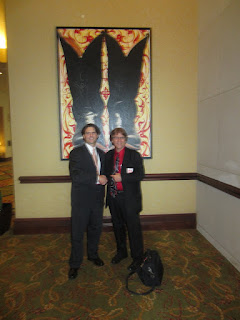


And then we all went over to Arnie Duncan’s invited talk. Note are below.

After the talk, Arnie Duncan went across the street to the Hilton. I got a couple of pictures of him on the way.


He went to a private room on the 2nd floor to meet with people from the Austin Chamber of Commerce. Thanks to a friend, I got to meet Arnie Duncan at this private meeting. Standing behind me was Karen Cator, a former Apple executive who is director of educational technology for the United States Department of Education. I had seen Karen at the NSF Cyberlearning Summit in DC back in January at National Geographic. Fortunately, she recognized me.

I guess I stuck out since I had a one day temporary badge (their badge printing machine was not working when I checked in). I also kinda stuck out since I was taking his picture as he spoke and I was not from the Chamber of Commerce in Austin. Still, before I knew it, I got to ask him a question about open education (I asked about the $2 billion OER initiative at the high school and community college levels that was announced back in June 2009). It was around that time that some folks standing behind me were wondering who I was (secret service?). Smile. Karen Cator recognized me and I got to stay. Arnie Duncan, in fact, answered the question--new developments are coming in the next week or two. A picture from the intimate session is below.

Though I did not realize it at the time, standing next to me was Geordi LaForge (i.e., actor LeVar Burton) from Star Trek Next Generation. He was also Kunta Kinte from Roots (back when he was around 20) and the host and executive producer of Reading Rainbow. Very cool. On the other side of me, were some venture capitalists and other high ranking Austin officials. In addition, I met a well known VP at PBS. His name is Rob Lippincott, Senior Vice President of Education for PBS. He was really interesting. Here is a picture with him and my friends Michael Mayrath and Priya Nihalani from GetYaLearnOn (GYLO). GYLO is pushing ahead in the digital book and mobile learning space.


Here are my quick unedited notes from Arnie Duncan's Keynote at the SXSWedu conference in Austin. I should point out that this conference had 3,000 people this year in just its 2nd year (Year #1 last year had 1,000 people). That is some huge growth.

= = = = = = = = = = = = = = = = = = = = = = = =
Arnie Duncan's Speech at SXSWedu:

These are my notes (the exact transcript from the U.S. Department of Education can be found at ED.gov from the U.S. Department of Education: The New Platform for Learning; March 8, 2012).

Per Arnie Duncan: I should tell you that my wife and kids laughed when he got asked to speak at a technology conference. I am known as a dinosaur in terms of technology (at least in the past I was). But, at least to some degree, that has changed. I have had to change. No doubt about it, technology is a game changer in education.

Technology offers many things including greater personalization of learning. It also eliminates geographic barriers to knowledge. It replaces the bubble test. Technology is the new platform for learning. And technology competency is not an option any longer. Progressive educators are using technology in bold ways to change educational possibilities. Take, for example, Marks Edwards, Superintendent, from Mooresville, South Carolina (as an aside, see this NY Times article; it may require a password; here is a PBS news story and interview as well as video that does not require a password--very interesting).

Duncan continues...He gave students in grades 4-12 a laptop. It increased readings, retention, and math test scores. Mark’s teachers are roaming conductors. The teachers (and the technology) can challenge student 1 on 1. Cost not prohibitive. It only costs a dollar or so a day to do this in terms of their technology costs per students. They are not spending more than other districts; instead, they are spending smarter.

Here are some more successes. The Open High School in Utah--they are adopting all digital content and no physical textbooks which are quite expensive. The Florida Virtual School—they have close to 100,000 students attending virtual schools. Then there is Idaho which is making huge strides in offering online classes to all students (see Idaho Digital Learning--as an aside, I spoke at their online conference last summer). I should also mention Joplin, Missouri (see March 7, 2012 article in Edudemic); this includes $500,000 donated by the UAE by the way. After the tornado tradegy, students came back to school and got their own laptop. Finally, at the School of One in NY which I visited, all students have technology and are engaged in their own learning.

In terms of initiatives at the federal level, in 2010, we issued a comprehensive technology plan (National Education Technology Plan 2010; more info here). Some 47 states have adopted. With this plan, there is hope to tailor information to student needs as well as parents and teachers. Using technology, students (and teachers) can become more productive. I need to mention Karen Cator who is on my team in the Office of Educational Technology at the U.S. Department of Education. Karen can you stand up. Please give her a round of applause.

The list of panels at this conference is evidence of change—-thhere are sessions on interactive art, game design for STEM, etc. I see one session on "Supersizing the classroom" with some 3,000 students and beyond. I do not recommend such supersizing in most educational settings. But it can definitely change college introductory courses. Clearly, there is tremendous creativity here. While education moves slowly, the world is changing.

There is much potential with these changes. Keep in mind that K-12 ed is a $650 billion industry. And higher education is over a 1 trillion industry. As a result, there are loads of decisions about what and how to teach that we will face in the coming years.

Khan Academy is offering hope for kids and changing how they learn. Sal Khan is creating opportunities for kids to learn when and where they want.

In addition to the Khan Academy, there are many great partnerships emerging that are pushing states to be more friendly in the use of technology in education. Former Governors, Bob Wise from West Virginia and Jeb Bush from Florida, involved in that.

The Obama Administration has done much including $4 billion in Race to the Top monies. In addition, much attention is now placed on STEM (Science, Technology, Engineering, and Mathematics). There is also the Recovery Act and a push to increase broadband access. Of course, we are trying to close the digital divide. Targeting low income opportunities to connect to the Web.

In higher education, we have done much. For instance, Pell Grants have gone from 6 million to 9 million in 3 years. And, as we all know, community colleges are bursting at the seams with more and more students. Some community colleges have 12,000 students on their campus in a single day (I think that is the number he said).

All told, educational technology can provide educational equity and level the playing field. It definitely gives a boost to students with disabilities. Technology helps teacher leaders in tough schools. We must continue to de-privatize education (I really do not know what he meant by that). (A pic is below).


Technology can individualize teacher training programs. Technology can help in many aspects of education. Assessment is behind everything—but education lags behind in this area (i.e., assessment). Technology must make learning interactive, effective, engaging, and fun. More that the classroom mimic the real world, the more engaged kids will be in learning.

Superintendent Edwards talks about the engagement and creativity—with one click you can go beyond your classroom and community. It challenges kids to think critically. College kids can access open access books and articles to reduce costs. All the curricula that they are trying to create are open source and open access.
Sal Khan has 2,700 video and 190 million downloads since he started and it is free. MIT, Yake, Tufts, and others are doing this. China, India, Brazil, etc. American entrepreneurs need to lead the change. I am here today to plead with you to support technology to change education.

We must educate our way to a better economy. We need both teachers AND computers. Great technology can transform the lives of many people. Next week, much cutting edge music will be here in Austin. People coming will have cell phones, iPads, mobile devices, etc., and will share their work in countless ways. People are sharing and recording in countless ways. So many ways that the sharing of music happens today. Still technology cannot write “Born to Run” or “Let it Be.” Technology is a critical tool to learn and to teach.

We must educate our way to a stronger economy. Technology tells us so much about ourselves and others. Yet, we come to Austin since there is no substitute for FTF interaction. The future of American education includes access to technology. But a great teacher is still needed to inspire us and help us. Teachers take your products from the drawing board to the classroom. Our kids are waiting for it and wanting it to happen now.

Thank you so much and I am happy to take your questions.

(Note: The above text is not a direct quote or perfect transcript as I added my interpretation and transitions as well as linkages to associated Web resources and articles. Nevertheless, it is pretty close to what he actually stated.

Again, if you want the exact transcript, see ED.gov from the U.S. Department of Education: The New Platform for Learning; March 8, 2012.)

Question and Answer from the audience at SXSWedu...

Person #1. What about college costs: Working on ways to reduce costs.

Per Arnie Duncan:
This past year, 40 states reduced funding to higher education. Our priorities are out of whack. Universities must try to maintain costs or reduce costs. In budget proposal, there is $5 billion of incentivize states. There are real challenges on the higher education side. We need a college scorecard—for actual costs. Both states and universities must step up.

Person 2. What is the role of for-profit gaming companies and video companies in education?

Per Arnie Duncan:
I believe that both for-profit and non profit organizations are very important; especially for STEM. (Note: this was a very weak answer. There were no creative ideas offered about how the for-profit industry could work with different educational sectors...I wanted to hear more about potential joint research and development, awards and recognitions, incentives, partnerships, proposals, etc. Nothing. Just, ya, "I believe that both are important.")

Person #3. Teacher satisfaction and morale is low. What to do?

Per Arnie Duncan:
The Recovery Act saved hundreds of thousands of jobs. The status of the teaching profession has been beaten down. Technology cannot do it by itself. Teachers are way underpaid. I think that we need to double the salary. We lose too much talent. As a country, our values must change. The vast majority of teachers are high performing. In Korea, they treat teachers as Nation Builders. That is how they are viewed in Korea. I would like teachers in the USA to be treated more like that.

Person #4. In terms of building connectivity, in all of your travels to other ministries and departments outside of the USA, what would you like to see here?

Per Arnie Duncan:
The jobs go to where the knowledge workers are. We have the 2nd education summit coming up. In Singapore, 90 percent of people are not allowed into teaching. They screen out the lower performers. And they compensate teachers better. There is a high bar to entry. More support and respect. And better compensation. Such an approach will change the country here. Talent matters. We need to attract great talent. That talent will transform this country.

Person #5. What about the “Learn to Earn” act. Tell me about it…?

Per Arnie Duncan:
I am a huge fan of entrepreneurship. Not just theoretical and book learning. We must encourage it. Gives relevancy in the community. (Again, not much of an answer here. So, for more on the Learn and Earn Act, see this article in a Policy Forum Blog. This blog post from Lynn Miller Associates is even better; apparently, the goal is "implement high quality entrepreneurship programs in communities all across the country.")

Person #6. I am a public high school teacher in Texas. Thanks for your words of wisdom. I would like to know how you can account for the cognitive dissonance between No Child Left Behind and what kids need in the real world.

Per Arnie Duncan:
Are you from Texas? I am going to meet with your governor (Rick Perry of Texas) to talk to him about a waiver for NCLB. There are 11 states with such a waiver already. (Some laughs, snickers, and applause.)

Person #7. Mass communication student who works in the non-profit sector. I no longer have subsidized loans. I used to have them but then I was suddenly cut off. What gives? I was given no notice. What can I do?

Per Arnie Duncan:
I would like help you. See my people here and ask them to check into it...and I assure you that they will. (Again, more snickers and faint applause.)

= = = = = = = = = = = = = = = = = = = = = = = =

It was great to meet him:


The end. More soon when I land. Well, my plane did not land until 7 hours after it was supposed to. I got home to Bloomington at 4 am and had to drive up the following day to keynote the Midwest Scholars Conference in Indianapolis which was run by Indiana Wesleyan University.

Ok, I have updated this blog post 3 days later (Sunday March 11, 2012). Hope it is improved. Time for a run.

Sunday, 19 February 2012

Pushing Off for the Philippines: Presentations, Papers, and People, and

I am sitting in the Indianapolis Airport. I am on my way to the Philippines for the first time. Tried to get here a couple hours early to catch an earlier flight to Atlanta but they cannot change my flight. Ug. Got economy comfort for most of the floght except from Altanta or Narita, Japan. That will be a long haul cramped up like a sardine.

As per usual on such flights, I will have the fun and lovely experience of grading papers from my R546 class on instructional strategies. This is a Saturday class from 8 am to 1 pm that I teach each spring for 8 weeks. Yesterday, we met twice in order for me to go. Super ug! But we made it through. I had the Indiana Teacher of the Year, Stacy McCormack, present during the 2nd session, She is a real dynamo. And she is a role model for my students as she illustrates how creativity + hard work can land you a trip to the White House and a photo-op with President Obama. Stacy teaches chemistry and physics, both of which are critical areas targeted by the federal governnment. No textbooks or boring lectures for Stacy. Nope, she believes in highly active and interactive lab experiences.


Anyway, as I said, I am heading to a conference in the Philippines. You can always get my current (and previous news and travels off my homepage. I will give a plenary talk on Thursday at 1st International Conference on Open and Distance Learning. The theme is creating spaces and opportunities. They expect about 300 people. Color PDFs of my talks (including a 3-part masterclass on Wednesday) as well as my plenary session are posted to my archived talks in TrainingShare.com. You will also find my new paper on Extreme Learning there. I wrote this in a day...think it came out ok (stole much from a recent NSF grant proposal; actually from sections that we had to delete due to page length limitations). Extreme Learning is my new research focus (see team and mission and such).

Please send me a note if you will be in Manila for the conference this week Wednesday to Friday. It shoud be great.

I will also do talks at 2 universities south of Manila (Feb 21 and Feb 28). I'll be back on the 29th. Color PDFs of my 8 talks can be found at my archived talks in TrainingShare.com as well. I will speak at the University of Batangas . After it, I will get a couple of days at Boracay Beach. Boracay beach is ranked top 10 in the world). My speaking will end at the University of the Philippines Open University on Tuesday February 28th. And then I fly back on the 29th.

My friend Dr. Melinda (Mel) Bandalaria from the UPOU is arranging it all. Sweet. She is so great. Back in 2008, she was among a group of about a dozen people who helped me run a symposium on e-learning in Asia at the E-Learn conference. Those presentations later became articles in a special issue of the International Journal of E-Learning and then a print-on-demand book with AACE. It will be fanstic to catch up with Mel and meet many new friends in the Philippines. I know my friend Dr. Kumiko Aoki from the Open U of Japan will be there as I just got an email from her.

I will update this blog from the Philippines. When I return, I will attend the annual IST conference in my department at IU March 2nd and then the SITE conference in Austin, Texas March 6-8th (see our special back-to-back symposium in Austin on emerging learning technologies that Mimi Lee from the U of Houston and I are arranging there). Finally, I will keynote a conference for Indiana Wesleyan on March 9-10 in Indianapolis. Wow.

Time to board for Atlanta.

Monday, 6 February 2012

Cracking the Whip: FEDx Videos from the NSF Cyberlearning Research Summit at National Geographic in DC

So, is NSF cracking the whip to better understand how to impact learning with technology? I think so...well, actually, what I detail below was a quite friendly, informative, and engaging event. Much life. Much energy. Much passion. And dozens of exciting visions of the future of learning.

What am I talking about? A couple of weeks ago (January 18, 2012), I had the extreme pleasure to present in the Grosvenor Auditorium at National Geographic during the Cyberlearning Research Summit for the National Science Foundation (NSF) in Washington, DC. This event, which was organized by people from Stanford Research Institute (SRI) and Lawrence Hall of Science along with NSF, was one of the most unique and engaging events of my life. In additon to NSF, organizations like the Gates Foundation were among the sponsors. Not surprisingly, the audience was packed with interesting people to meet.

People flew, drove, walked, ran, taxied, bused, and subway rode into the event. As a result, I got to see many friends at the event, including Tom Reeves from the University of Georgia, Roy Pea from Stanford, Sarah Haavind from Leslie University, YaTing Teng from Adobe, Michael Wenger formerly of Sun Microsystems, and I finally got to physically meet with Christine Greenhow who is now at Michigan State University (we have met in the cyberworld of conference event planning a couple of years back). Both Tom Reeves and Mike Wenger have chapters in my 2006 Handbook of Blended Learning, so it was great to introduce them to each other. In addition to the folks mentioned above, my fantastic friend, Dr. Sherry Hsi from Lawrence Hall of Science was among the main organizers. Here is a list of the organizers.

Organizers
Summit Chairs

Jeremy Roschelle, SRI International, Menlo Park
Sherry Hsi, Lawrence Hall of Science, UC Berkeley

Advisory Committee, Reviewers, & Editors
Chad Dorsey, Concord Consortium
Daniel Edelson, National Geographic Society/National Geographic Education Foundation
Judi Fusco, SRI International
Chad Lane, University of Southern California
Linda Polin, Pepperdine University
Mimi Recker, Utah State University
Patricia Schank, SRI International

As a TED-like event, we each got a short amount of time to make our points. It was NOT TED, however. Given it was for the federal government, I wanted to call these FED talks. Someone else said that they were TED-ED talks. I countered that is was like one of those special TEDx talks, so about FedEx. Ya, like FEDx, the delivery was very fast with mostly on time deliveries. And no one messed up. In the practice session the day before, there were various technology issues and hang-ups. But these were ALL taken care of (Sherry Hsi made sure of that...she cracked the whip...smile Sherry...just kidding my friend. Sherry was awesome in getting us prepared). Thanks to that practice, only one person had a video that would not play and he had a back-up plan so all was well.

There were around 24 speakers that day who each got about 10 minutes to discuss their research and vision of the future for learning with technology. There were also opening Welcoming Remarks from Danny Edelson from the National Geographic Society Janet Kolodner from the National Science Foundation, and Jeremy Roschelle from SRI International. After that, to "Set the Stage," we heard from my friend, Constance Steinkueler Squire from the White House Office of Science and Technology Policy (who was interviewed and quoted in the USA Today last week in an article on the benefits of video games and what the White House is currently doing in this area to promote gaming). The day ended with a closing reflection from Karen Cator from the US Department of Education. I enjoyed her quick comments and insights. I should also point out that Jeremy Rochelle acted as the host for the day and introduced each sections of talks. He too did a marvelous job.

The Cyberlearning Summit speakers were all nominated and then they had to put in a proposal. Only a few were selected (I was most lucky). Do check out the amazing speakers and their bios, the program, location, the topics, the graphics and videos of the talks, and more information exists in the About section. The also had a scrolling list of quotes from many researchers, scholars, and educators that played throughout the day.

For those like me who have a preference for visual representations of ideas, they hired a graphic facilitator to draw out our talks (here is a sample...a visual was drawm for each set of 4-5 speakers; mine is not yet posted). How cool is that! I has only happened to me once before (back in February 2011 in Saudi Arabia). The artist was Jim Nuttle. I highly recommend him.

Here is part of the description in the Cyberlearning Summit wiki:

"The Cyberlearning Research Summit was a high-profile gathering in Washington DC, featuring top quality research-based speakers who shared visions for the future of learning with emerging technologies. In the style of the TED conferences, speakers aimed to:

Discuss big ideas on at the intersection of emerging technology and research on learning;

Articulate the “transformative potential” of a direction or approach;
Communicate a sense of the broad research on this topic;

Engage, inspire, and stimulate thinking in this new program area.

Building on those visions, participants gathered as birds-of-a-feather to crystallize a sense of the unique opportunities that should be the focus of the research community now. We seek a community sense of how to couple the learning sciences with related fields of innovation to leverage new technology affordances for the deepest learning outcomes. Through the contributions of diverse participants, the summit sought to exemplify the “transformative potential” of cutting edge research and development to dramatically advance learning – and is expected to be influential in identifying promising directions for advanced R&D efforts."

There is now a YouTube Channel with these talks. My talk, "Stretching the Edges of Technology-Enhanced Teaching: From Tinkering to Tottering to Totally Extreme Learning" was just posted. This talk summarized explained the casual informal learning settings brought about by technologies such as Wikipedia as well as those deemed more extreme. See the new Extreme Learning website that my team is in the midst of designing.

I hate watching myself speak and, so, I have only watched a few seconds of my talk, but others say they like it. You can find it here. As you will see, I eventually found my way into my Indiana Jones (i.e., Indiana Curt) outfit, but did not feel comfortable enough to crack the whip during the 10 minutes (where were my friends, Aaron Doering and Charlie Miller from the University of Minnesota, when I needed them?). I did, however, get the audience to shout "WE-ALL-LEARN" a couple of times (based on my World is Open book) and jump up and down. You will have to watch to see I guess. I cannot watch it.

There are many brilliant talks from that day on mobile learning, robotics, virtual humans, cyber-civics, big data visualization, and complexity models of different kinds. One of my favorites was William (Bill) Swartout's talk, Virtual Humans for Learning. It is a definite must see! See also my old friends Elliot Soloway and Cathie Norris discuss mobile, "Yes We Can-Now: All K-12 Teachers Enacting Learn-by-Doing."

How might you use? Here are 10 quick ideas off the top of my head.
1. Create a complete course around these videos on emerging technology for learning. As part of this, you might interview 1-2 of the presenters each week.
2. You might crack the whip and assign your students to watch ALL of the videos for one week of a semester.
3. Require students to read the research of particular presenters and then watch their video or vice versa.
4. Assign your students watch each of the 5 Talk Sets for themes.
5. Have your students select their favorite presenter and write to him or her.
6. Have your students engage in a role play related to different presenters, perhaps in a class symposium session (this is what I like to do).
7. Have your students create a wiki glossary of the key points of each presenter.
8. Organize virtual discussions of 1 or more the various presentations and ask the presenter to come in and lend feedback on the points made.
9. Assign different students to blog on each session.
10. Have students reorganize the session presentations for the day in a way that makes most sense to them.

There is much you might find useful from that day.

What a totally cool day! They need to do this again. Perhaps an annual event.

Of course, when we were done, there was a free reception (and drinks) in a wonderful open rooom at National Geographic. Oh my, what a day. We got on the bus at 7:15 am and got back at 10 pm or so. When I got to my hotel, my dear friend Paul Kim from Stanford University and Seeds for Empowerment arrived for a chat. He just happened to be in town for a meeting intended to change the world (I thought I had just attended one such event but Paul's was equally world changing). As an aside, Paul and my son Alex Bonk (Jabonk Productions) go to Tanzania this week to work with teachers and students there using mobile devices. Alex will do some facilitation of the training but is mainly there for his photography and filming skills. I think if NSF does another one of these events that Paul Kim should be first on their list to present. That guy is phenomenal.

I took 4 or so pages of notes from the NSF Cyberlearning Summit. Perhaps I will blog post all of that. Is anyone interested in reading?

In the meantime, watch some of the videos from January 18th. Or do I have to crack the whip?